A cyclist’s position on their road bike is unique and differs from that of any other individual. This is because the optimal position is the result of a combination of morphological, functional, and postural factors.
To obtain a reliable and scientifically valid biomechanical assessment, it is equally important to evaluate the cyclist in the most appropriate and representative position.
Although many amateur cyclists prefer to rest their hands on the brake hoods for greater comfort, this cannot be considered the reference posture for a proper bike fit.
This misconception often stems from habit rather than from the analytical study of biomechanical reference indicators.
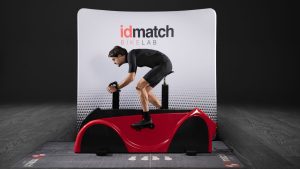
Why the hood position is not valid for a biomechanical assessment
- It removes the influence of handlebar geometry
When the cyclist places their hands on the brake hoods, the effect of the handlebar — especially its drop and reach values — is completely excluded.
In this setup, different handlebars would not produce any meaningful change in the cyclist’s position, preventing an accurate evaluation.
- There is no scientific data supporting the hood position
No scientific studies define the hood position as a valid or comparable reference posture for determining optimal bike fit parameters.
Conversely, available research indicates that the correct and most accurate position for analysis is with the hands in the drops.
Why the assessment must be performed with hands in the drops
The drops position:
- takes into account all morphological and dimensional characteristics of the handlebar, which play a crucial role in defining the overall position;
- produces a biomechanical outcome that remains comfortable and effective across all other hand positions (tops or hoods);
- aligns with the functional logic of cycling posture changes, which alter elbow, shoulder, and lumbosacral angles to transition from a more precise and aerodynamic position to a more relaxed one.
The idmatch Approach: Why the Drops Matter Even More
idmatch, in its automatic assessment mode, evaluates the cyclist with hands in the drops, as this is the position where the body experiences the highest level of stress — both in terms of center of mass and load distribution on the handlebar.
Studies conducted using idmatch have demonstrated that:
- If an optimal position is achieved in the most stressful scenario — with hands in the drops — the resulting bike setup remains valid and biomechanically efficient even when the rider places their hands on the tops or on the hoods.
- The opposite is not guaranteed:
A fitting performed using the hood position does not ensure a correct or functional posture when switching to the drops. In fact, the absence of handlebar geometry influence makes the hood position not representative of the true riding mechanics.
This is why idmatch places the cyclist in the most demanding yet most informative posture: it ensures that the resulting setup is stable, efficient, and transferable across all real‑world riding conditions.
Analysis position vs preferred riding position
It is essential to distinguish between:
- the position required for the biomechanical assessment, which must be scientific, repeatable, and representative;
- the position the cyclist prefers during everyday riding, which may prioritize comfort.
To ensure comfort, performance, and stability in every riding condition, the assessment must be carried out with the hands in the drops, fully incorporating the ergonomic and dimensional features of the handlebar — exactly as idmatch does in its process.


